
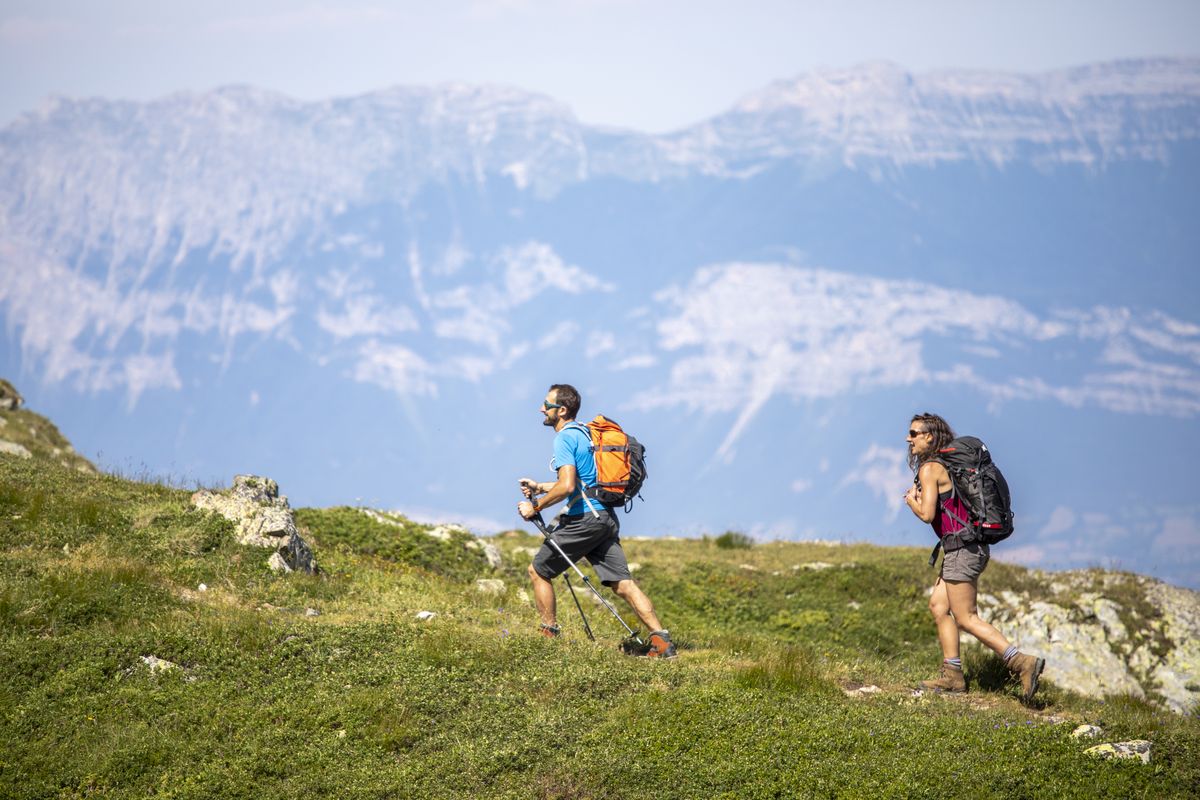
4-day Tour du Taillefer
 Hard
HardYou leave one civilisation for another: the civilisation of the mountain dwellers. Meet people, share daily lives that are very different from our own, and explore wild nooks and crannies with exceptional natural riches. It’s all there.
Important information
Dans le Parc national des Écrins, les sentiers sont généralement praticables de la mi-juin à fin septembre.
Toutefois, les périodes d'accessibilité des itinéraires et les dates de pose des passerelles varient d’une année à l’autre en fonction de l’enneigement, des dégâts survenus en hiver et des conditions météorologiques. Par ailleurs, l’état des sentiers n’est pas contrôlé quotidiennement et peut évoluer rapidement après un évènement météorologique (orage, crue...). Il est nécessaire de se renseigner auprès des maisons du parc national et des offices de tourisme du territoire avant votre sortie. Pendant la randonnée, en cas de passage dégradé ou dangereux, faites demi-tour et signalez-le.
4 steps

Description
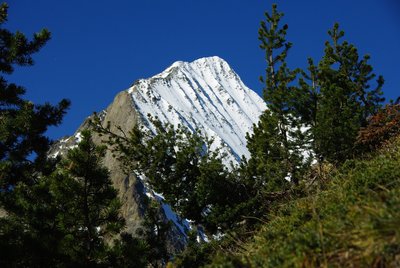
We begin by going upwards and savouring the high mountains, via the Col de Corbières (1926 m), and the little mountain village of Villard-Reymond (the second highest village in France).
The next day, you go down towards the Lignarre torrent, crossing it near the village of La Palud, before going up towards the hamlet of Ornon and tackling the ascent that will take you to the Taillefer refuge (2056 m).
You now begin to explore the magnificent landscapes and the special atmosphere of the lake plateau, which you will fully experience the next day for your last stage, taking you back to the resort of Alpe du Grand Serre.
And it’s not finished! From Alpe du Grand Serre, you still need to go up to Plancol, to admire the view over the Ecrins and Le Grand Armet. Then, during the descent, you pass through a few dizzying sections and return to the starting point: the Col d'Ornon.
- Departure : Col d'Ornon
- Arrival : Col d'Ornon
- Towns crossed : Chantelouve, Ornon, Villard-Reymond, Oulles, Livet-et-Gavet, La Morte, and Lavaldens
18 points of interest
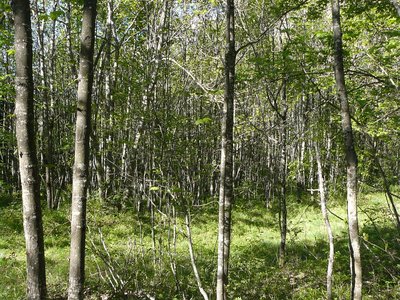
Aulnaie blanche du col d'Ornon - Site Natura 2000 - © Parc national des Ecrins - Justine Coulombier  Flora
FloraWhite alder forest
The forest is mainly made up of white alder trees. Their name comes from the fact that the underside of their leaves is covered with a whitish and silvery down. The alder forests grow alongside mountain streams, and to develop need land that is regularly subject to flooding. Due to damming and the removal of materials from the river beds, the white alder is now rare in Europe. The white alder forest in the Col d'Ornon is listed as a site of national interest and is part of the Nature 2000 network. It is the biggest in France, covering some 250 hectares. It can be seen along the Malsanne, the Merdaret and the Lignarre.
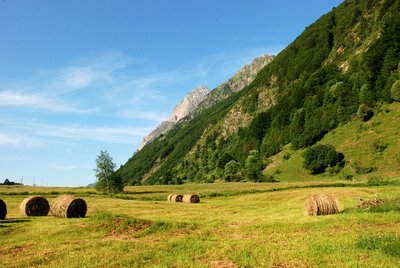
Prairies de fauche du Col d'Ornon, Natura 2000 - © Parc national des Ecrins - Bernard Nicollet FloraThe Col d’Ornon hay meadows
Agricultural specialists consider that a meadow is natural when it has neither been manured nor ploughed for ten years. These meadows are very rich in flower species, and consequently they are the home of a whole host of pollinating insects, including bees, of course.
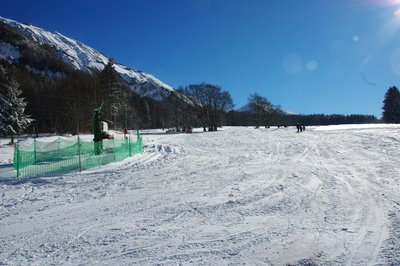
Station de ski du col d'Ornon - © Parc national des Ecrins - Emmanuelle Boithiot  Vernacular heritage
The Col d’Ornon ski resort
The small ski resort of Col d'Ornon has two separate districts.
First, the Plan du Col (lower down) with its magnificent green slope. Here the resort’s first button lift was opened in 1965, in the early days of popular skiing holidays!
The Bois Barbet button lift (above), was opened in 1973. With a 450 m descent and an average slope at 36%, this button lift is a real technical feat. Although it no longer really meets the requirements of modern-day comfort, it continues its life as a tricky button lift running to the exceptional red and black slopes.
In winter, the resort hires four extra employees and works with a network of volunteers, who mobilise in support of the resort, making it a real centre of activity for locals and tourists.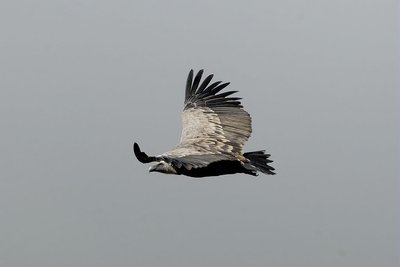
Vautour fauve - Coulon Mireille - PNE  Fauna
FaunaGriffon vulture
In summer, the griffon vultures leave their nesting areas, attracted by the many sheep grazing in the Alpine pastures. They soar up above the mountain crests. Expert scavengers, they have a fundamental role in the food chain, quickly eliminating corpses and so limiting the risk of disease spreading. This task as nature's undertakers has long made them an object of horror and fear for mankind. They are in decline in the Alps, but once again present in the Massif des Ecrins, following programmes to reintroduce them since 1980 in Les Causses and more recently in the Prealps.
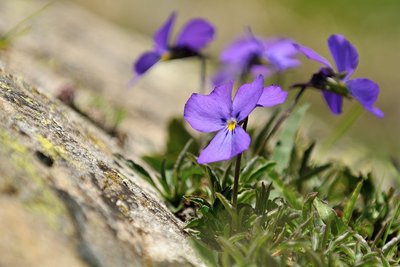
Pensée des Alpes - Mireille Coulon - PNE FloraPansies
In a carpet of violet flowers, but sometimes yellow, white or multi-coloured, the Alpine pansy brings colour to the grass. It is also known as the mountain violet. Its spur, which can be seen on the back of the flower, is long, and only insects with long sucking pumps, such as butterflies, can gather pollen from them. Violets and pansies are members of the same family. To tell them apart, you need to look at the two side petals: they are turned downwards in violets, and upwards in pansies. Pansies are optimistic violets!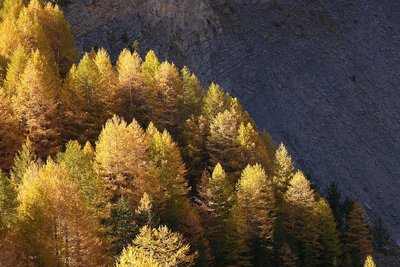
Mélèzin d'automne - Thierry Maillet - PNE FloraEuropean larch
With a rich range of colours varying with the seasons, the fine and soft needles of the larch turn from light green in spring to emerald green in summer and gold in autumn. In winter, they fall, and the majestic larch seems to be dried out. Only the small round cones persist, which birds take to pieces to peck at the seeds. The flowers blooms at the same time as the first supple needles in spring: the female flowers have small raspberry-coloured cones and the male flowers are pale yellow catkins.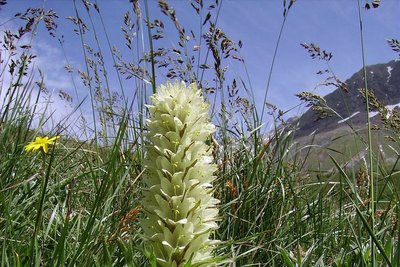
Campanule thyrsoide dans une pelouse à grande fétuque - Bernard Nicolet - PNE FloraYellow bellflower
This campanula is easy to recognise, with its tufts of highly compact yellow flowers. It is one of the few Alpine biannual plants. The seeds scattered in autumn produce large, slender leaves the first year, growing in a rosette shape. The flower only blooms the second year, when it ensures its posterity, then dies. The plant can be found on Alpine grassland (from altitudes of 1,000 to 2,600 m) and on rocky ground and soil that is rich in limestone. Standing on a thick, hollow stalk with a great many leaves, it is 10 to 40 cm tall.
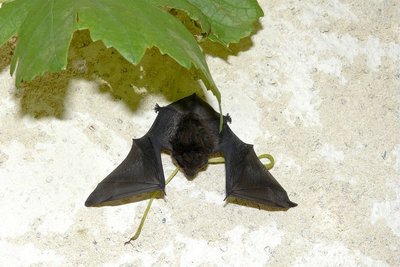
Pipistrelle commune - Jean-Pierre Nicolet - PNE FaunaCommon pipistrelle
Brown in colour with relatively short ears, the common pipistrelle and the kuhl's pipistrelle are rivals for the title of Europe's smallest bat. The common pipistrelle can be found in a wide range of ecological environments, even above an altitude of 2,000 m. In late 19th century France, school books celebrated the virtues of the bat. They are insectivores, eating a quarter or a third of their weight each day in mosquitoes and other insects. They emit ultrasounds that cannot be heard by the human ear. This technique helps them to find their way in the dark and capture their prey. They are often to be seen around lampposts, hunting insects that are attracted to the light.
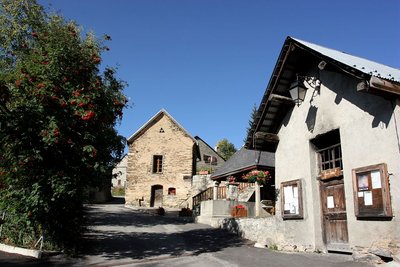
Villard-Reymond, le village - © Parc national des Ecrins - Pascal Saulay  Architecture
Villard-Reymond
Perched at an altitude à 1640 m, this is the highest village in Isère, and the second highest in France. 40 people live here today (but just six permanent residents), while there were almost 300 inhabitants 150 years ago. The fairly gentle slopes and favourable orientation gave rise to pastoral farming, despite the high altitude. The farmers used to work at the Ornon slate works, the women worked at home for glove-makers in Grenoble. Access to the valleys has always been difficult, and in 1960 a cable car was used to take cattle down into the Bourg d’Oisans plain. Today, people live in and visit Villard-Reymond for the quality of its environment.

 Know-how
The Ornon slate mines
Near Ornon, the route regularly unveils slate deposits. These black rock sheets are commonplace here. Slate was for a long time mined, providing a certain amount of prosperity to the village. A century ago, 9 quarries employed 250 people. The slate was used for roofs, but their quality was much in demand, and sometimes was exported. The quarries were worked in the winter, since the workers were farmers the rest of the year. Industrial materials began to compete with natural slate, and mining came to a halt in about 1950.
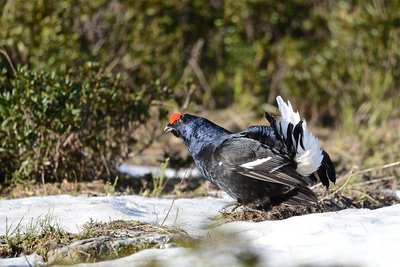
Tétra-Lyre en parade - © Parc national des Ecrins - Rodolphe Papet FaunaThe black grouse
To observe black grouse in summer, you need to get up early. In France, black grouse (or blackcocks) can only be found in the Alps. In spring, the male with its black plumage and lyre-shaped tail with white under-tails parades to attract females. In winter, they spend most of their time in igloos dug out of the snow to protect themselves from the cold. This is a particularly sensitive period because they cannot replenish the energy used up when they must leave their igloos suddenly if an off-piste skier or show-shoe hiker passes by.
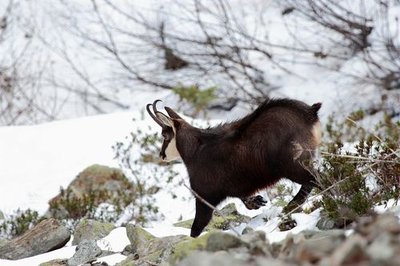
Chamois mâle en hiver - Christophe Albert - PNE FaunaChamois and rock ptarmigan
While hundreds of sheep graze on the edges of the plateau, higher up, on the nearby crests and summits, chamois and rock ptarmigan may be seen. These animals are the emblems of high altitudes, with the first nicknamed the “goat of the rocks", and the rock ptarmigan sometimes known as the “snow partridge". If you want to get a good look at either of them, you must leave them undisturbed: binoculars or a telescope are essential.
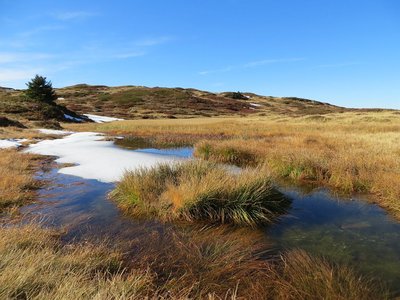
Tourbières du plateau du Taillefer - © Parc national des Ecrins - Justine Coulombier  Water
WaterThe Taillefer Plateau peat bogs
The extreme conditions of humidity, acidity and cold holding sway on the lake plateaux mean that organic matter is not fully broken down, so it builds up in hollows to form peat. Peat bogs are extremely useful. They are remarkable, rare, fragile and extremely precious habitats that are characterised by exceptional biodiversity. Here you can find rare species that are adapted to these difficult living conditions (high humidity, low temperatures, poor soils). The most common plant is peat moss (sphagnum) - real sponges that can stock up to 30 times their own weight in water! Peat bogs also play the role of a filter by purifying the air and water. They reduce erosion, help renew the phreatic zones, naturally store carbon and protect from flooding and drought. Under threat from human activity and climate change, this natural heritage is monitored closely.
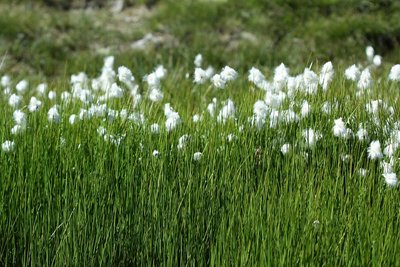
Linaigrette de Scheuchzer - © Parc national des Ecrins - Cédric Dentant FloraCommon cottongrass
Nicknamed “bog cotton", common cottongrass grows in wet and acidic soils, such as the peat bogs of the Taillefer. Common cottongrass, like the rock ptarmigan or the mountain hare, are fragile species, the remnants of a glacial climate and still living in the mountain range. It is a cotton-like plant with white plumes, and fruit gathered into a single, quite thick ball. The smooth stalk is round, unlike the other species of cottongrass, which are triangular.
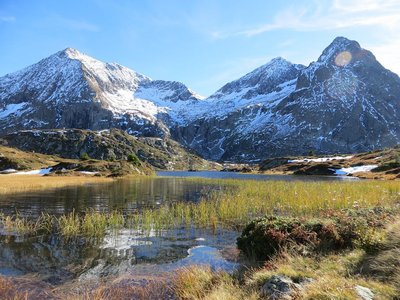
Le Lac Fourchu sur le Plateau du Taillefer - © Parc national des Ecrins - Justine Coulombier  Geology and geography
The Taillefer Plateau - Natura 2000 site
Recognised by the European Union for its great ecological interest, the Taillefer Plateau is listed in the Natura 2000 network. The network is made up of a series of European natural sites that are identified for the rarity or fragility of the wild, animal or plant species, and their habitats.
12,000 years ago, the withdrawal of the glacier from the Taillefer mountains shaped the landscape that can be seen today: a high plateau between 2,000 and 2,500 metres high, with a constellation of lakes mainly produced by old glacier abrasion; a plateau that presses down to the south on the abrupt and bare slopes of the summit of the Taillefer.
On the plateaux today there are over a thousand wetland and peat bog areas, a remarkable concentration, and one that is rare in the French Alps.
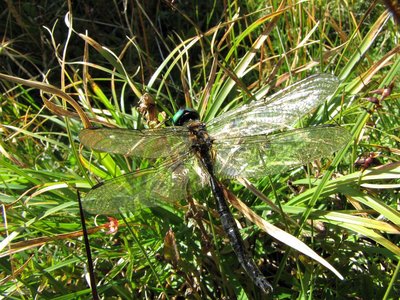
Somatochlora arctica - © Parc national des Ecrins - Christophe Albert FaunaThe northern emerald
The northern emerald is a dark-coloured dragonfly with a metallic green or shiny black body, contrasting with its lighter-coloured eyes. It is hard to tell it apart from other species in the genus. In the Ecrins, the species can only be found in the peat bogs of the Taillefer Plateau at an altitude of over 2000m, where it lives with its close cousin, Somatochlora alpestris.
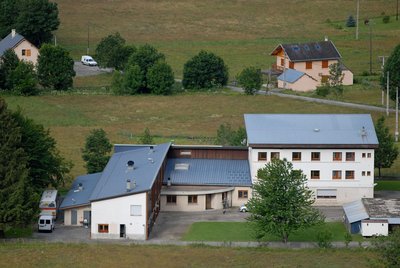
Centre LHC de Moulin-vieux - © Parc national des Ecrins - Pierre Masclaux ArchitectureRépublique des Enfants
The “Children's Republic” was an important experiment in education. It was part of the movement in citizenship education occurring in different parts of the world and advocating the respect for children. It began in 1946 with the arrival of children from the south of France or young Spanish refugees, most of whom were orphans. Here homes were gradually built, community centres and holiday camps. This explains this large building at Moulin Vieux, which is called the Colonie (camp) or the Republic, and which today welcomes travellers and holidaymakers.
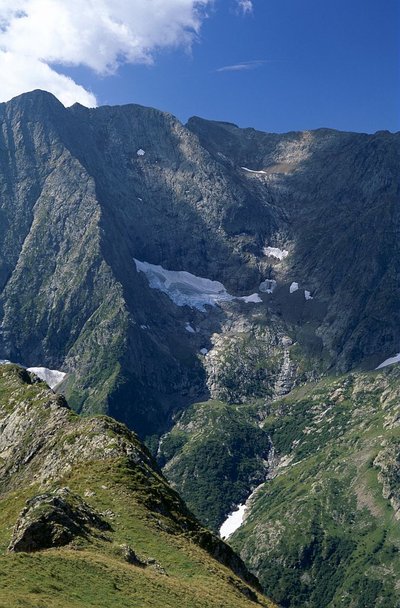
Le Glacier du Grand Armet - © Parc national des Écrins - Jean-Pierre Nicollet  Panorama
The Grand Armet glaciers
The Massif du Taillefer has hardly any glaciers left on its sides. In the first part of the ascent in the Roizonne valley towards Plancol, you go below the north face of the Grand Armet, which still has two glaciers. The higher one is called the Grand Glacier, and is valiantly resisting the widespread melting of the Alpine glaciers, despite a relatively low altitude (2250m), although it has greatly decreased in size over the past few years. The Grand Glacier is the most westerly glacier in the French Alps.
Forecast
Altimetric profile
Sensitive areas
Black grouse - winter
- Impacted practices:
- , Land
- Sensitivity periods:
- JanFebMarAprDec
- Contact:
- Fédération Départementale des Chasseurs d'Isère Yannick Buzzarello yannick.buzzarello@chasse38.com
Membres de l'Observatoire des Galliformes de montagne :
Virginie DOS SANTOS
ogm.vds@gmail.com
Blandine AMBLARD
ogm.amblard@gmail.com
Black grouse - winter
- Impacted practices:
- , Land
- Sensitivity periods:
- JanFebMarAprDec
- Contact:
- Fédération Départementale des Chasseurs d'Isère Yannick Buzzarello yannick.buzzarello@chasse38.com
Membres de l'Observatoire des Galliformes de montagne :
Virginie DOS SANTOS
ogm.vds@gmail.com
Blandine AMBLARD
ogm.amblard@gmail.com
Black grouse - winter
- Impacted practices:
- , Land
- Sensitivity periods:
- JanFebMarAprDec
- Contact:
- Fédération Départementale des Chasseurs d'Isère Yannick Buzzarello yannick.buzzarello@chasse38.com
Membres de l'Observatoire des Galliformes de montagne :
Virginie DOS SANTOS
ogm.vds@gmail.com
Blandine AMBLARD
ogm.amblard@gmail.com
Black grouse - winter
- Impacted practices:
- , Land
- Sensitivity periods:
- JanFebMarAprDec
- Contact:
- Fédération Départementale des Chasseurs d'Isère Yannick Buzzarello yannick.buzzarello@chasse38.com
Membres de l'Observatoire des Galliformes de montagne :
Virginie DOS SANTOS
ogm.vds@gmail.com
Blandine AMBLARD
ogm.amblard@gmail.com
Recommandations
Ask about the opening dates for accommodation.
Ask about snow conditions on the mountain passes early in the season.
Be careful in the descent from Plancol to Col d’Ornon - some very high sections and sections with cables.
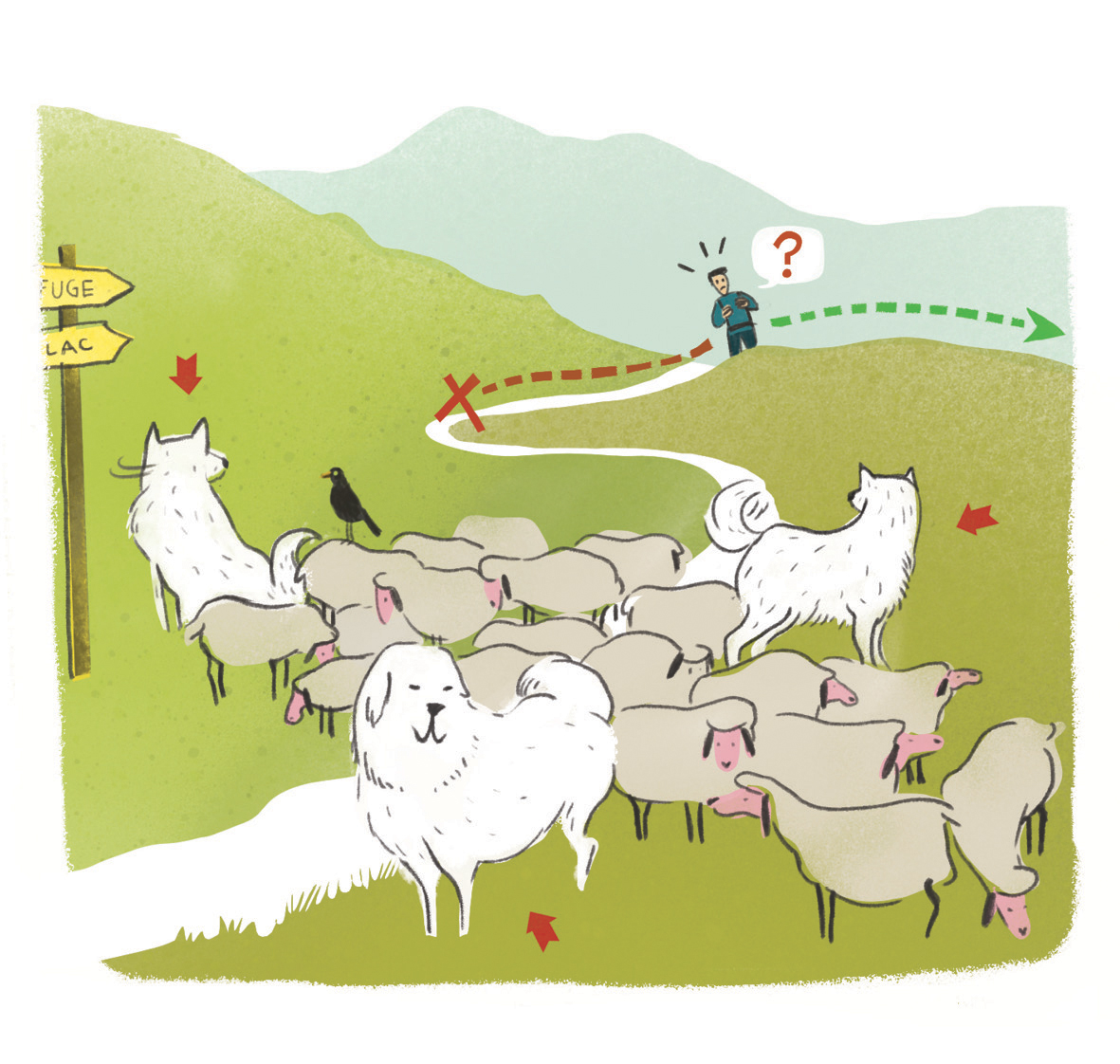 In mountain pastures, protection dogs are there to protect the herds from predators (wolves, etc.).
When I hike I adapt my behavior by going around the herd and pausing for the dog to identify me.
Find out more about the actions to adopt with the article "Protection dogs: a context and actions to adopt".
Tell us about your meeting by answering this survey.
Information desks
Oisans Park house
45 avenue de la République, 38520 Le Bourg d'Oisans
Video presentation of the natural resources of the Oisans mountain and its crafts. Information, documentation about the Park, projections, reading space for children. Accessible to people with reduced mobility. Free admission. All animations of the Park are free unless otherwise stated.
Maison du Parc du Valbonnais
Place du Docteur Eyraud, 38740 Entraigues
Reception, information, temporary exhibition room, reading room and video-projection on demand. Shop: products and works of the Park. Free admission. All animations of the Park are free unless otherwise stated.
Transport
www.voyages-sncf.com
By bus :
- Bus lines in Région Sud : https://zou.maregionsud.fr/
- Bus lines in Auvergne-Rhône-Alpes : https://carsisere.auvergnerhonealpes.fr/
- Bus lines in Isère : https://www.itinisere.fr/
Access and parking
- From Bourg d'Oisans, head for Grenoble along the D1091, then turn left onto the D526 as far as Col d'Ornon
- From Grenoble, head for Bourg d'Oisans along the D1091, passing Vizille and Rioupéroux, then, a few hundred metres before Bourg d'Oisans, turn right into the D526 and go as far as Col d'Ornon.
- From Entraigues, head for Le Périer along the D526 and go up to Col d'Ornon, towards Bourg d'Oisans
Parking :
More information

Source

Report a problem or an error
If you have found an error on this page or if you have noticed any problems during your hike, please report them to us here: