
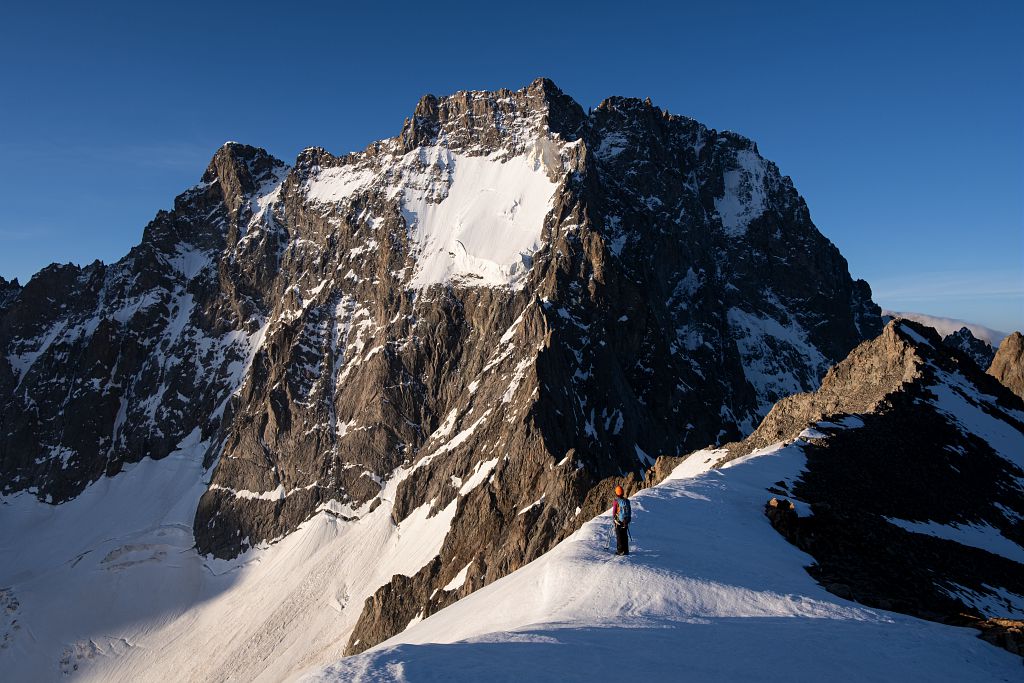
Pic Coolidge (3,775m)
 Hard
Hard2 steps

Description
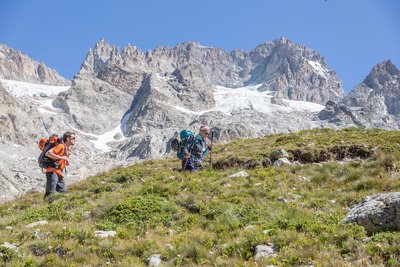
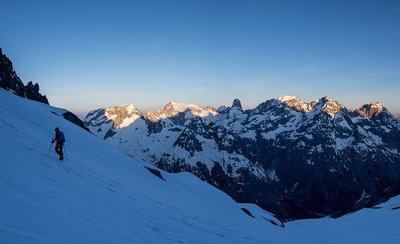
On the second day, we get to the heart of the matter with the ascent of Pic Coolidge. Leaving the refuge, you first reach the Col de la Temple-Épaule at 3,321m. You then have to climb 450m to reach the summit of Pic Coolidge at 3,775m.
Return to La Bérarde via the same route.
- Towns crossed : Saint-Christophe-en-Oisans and Vallouise-Pelvoux
12 points of interest
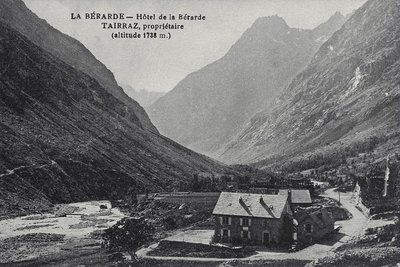
La Bérarde - Hôtel de la Bérarde - Collection PNE  History
Bérarde Hamlet
La Bérarde, is a hamlet representing the history of mountaineering and its corollary touristic development in the vallies. A heterogenous collection of welcoming buildings and businesses. So many modest but representative examples of the successive periods in time of tourist facilities on this emblematic site in the history of this valley.
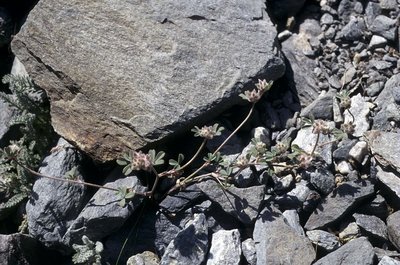
Trèfles saxatile - PNE - Nicolas Marie-Geneviève  Flora
FloraRock Clover
This small rare clover colonizes the moraines and the crystalline gravel like that at the confluence of the Vénéon with the Romanche up to the Chardon valley. With a whitish colour or pinkish its flowers are small and have white hairs that gives them a fluffy appearance.
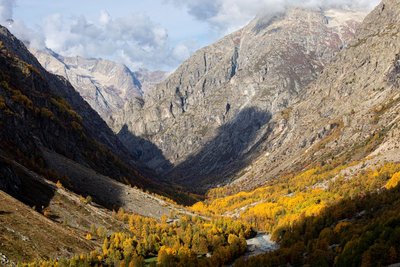
Automne en Oisans, la Bérarde - Thierry Maillet - Parc national des Ecrins HistoryThe beginning of the National Park in 1913
At the beginning of the 20th century, the need to protect the slopes of the high mountain at Haut Vénéon emerged in order to limit the erosion of the ground and the torrential flooding that the Omanche and its affluent the Vénéon were subjected to. Deforestation and pastoral exploitation were blamed at that time. So in 1913, after long negotiations the State bought around 4000 hectares of ground from the commune of Saint-Christophe-en-Oisans to make a « National Park ». The development of tourism and mountaineering spearheaded by the CAF and the Touring Club of France from the second half of the 19th century in the sector of Oisans was not unconnected from this either. The Inspector for Waters and Forests wrote that the creation of a Park would involve « advantages for the commune of Saint-Christophe as well as for the development of tourism in the Dauphiné ». This innovative Park, at that time, was not drawn up in relation to any written law or regulatory framework resulting in several vague points like the different denominations used (Bérarde, Oisans, Pelvoux, etc.).
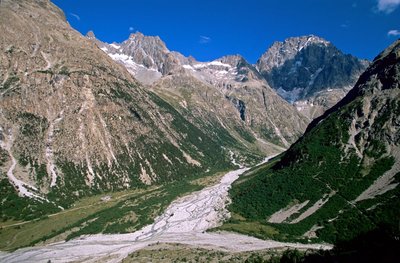
Le plan du Carrelet et l'Ailefroide - Cyril Coursier - Parc national des Ecrins HistoryThe creation of the Ecrins National Park
Lucien Devies, president of the Fédération Française de la Montagne and former President of CAF wrote a plea in the December 1963 issue of the CAF review for the creation of a « National Park in the Haut Dauphiné » on the perimeter of the Ecrins massif. The State Administration then took over. However, the project for a National Park in the Pyrénées was keeping the agents occupied. They had to wait until 1969 and a new intervention by Lucien Devis (still by way of the CAF review) for the project to be launched. A fact finding mission was given to Florent in 1971. After several phases of consultation and concertation with local politicians , le decree for the creation of the «Ecrins National Park » was signed on the 27th March 1973 over a protected surface of 91 800 ha. Making it the fifth National Park officially created. Others would follow; in 2013, France can count 10 National Parks...
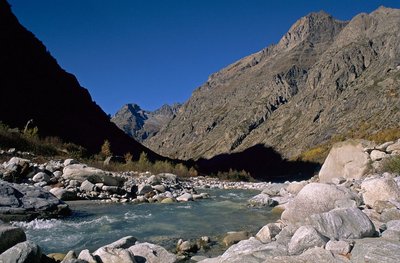
Le Vénéon à la Bérarde - PNE - Roche Daniel  Water
WaterHaut Vénéon
It’s in this valley that the Vénéon torrent has its source which gives its name to the valley. In the Autumn , then in Winter and Spring, the waters of the Vénéon have a remarkable colour depending on the light of the day... This particular shade can be explained by the strong mineralization which saturates the water and reflects the sun’s rays. In fact, under the action of the melting snow, the water runs in all directions and washes fine particles of silica more or less coloured and partially dissolved. You just have to collect some water, let it evaporate to see the very finely textured deposit: rock flour.
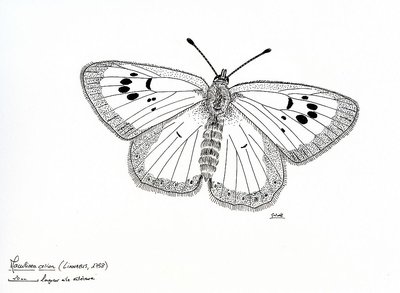
Azuré du serpolet - PNE - Grosselet Olivier  Fauna
FaunaLarge Blue Butterfly
This butterfly with blue wings spotted with black frequents the mountain grasslands and entrusts the ants with rearing its caterpillars... It lays its eggs on the host plant, the Breckland Thyme, whose flower buds feed the caterpillar until it lets itself fall to the ground. The Fire Ants take over. They are attracted by the honeydew produced by the caterpillar and they transport it to their anthill to milk it. . The caterpillar becomes carnivorous and eats the young ant larvae without being disturbed. It hibernates until the Spring. When it reaches maturity, it creates a chrysalis in the anthill. The butterfly hatches and quickly goes out in to the open air to carry out the reproduction of the species.
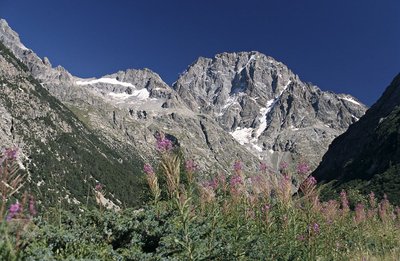
Versant nord ouest d'Ailefroide - PNE - Roche Daniel  Panorama
Conquest of the Ailefroide
By its magnitude, its height, its steepness, the conquest of the North-West face of the Ailefroide (impressive view of the North-West face of the Ailefroide which dominates Carrelet plain at an altitude of 3954 m) it is comparable with the famous Northern face of the Grandes Jorasses by Devies. The first ascent carried out by the corded team Devies and Gervasutti on the 23rd and 24th July 1936. On the approach from the Temple-Ecrins refuge Gervasutti broke a rib which did not stop him from carrying out this prestigious first.
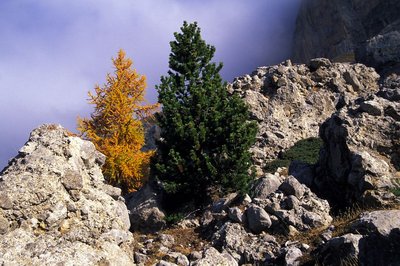
Pin à crochet (arbre de droite) - PNE - Nicollet Bernard FloraMountain Pine pinewood
The pinewood of Mountain Pines at Carrelet is rightly considered to be the highest in Europe. In fact, it occupies a slope at an altitude of 2400 m. It is also developing downwards due to the end of pastoral bovine activity at the beginning of the 1970s. Progressively, the grassland has been colonized by the juniper heath which encourages the implantation of Mountain Pine.
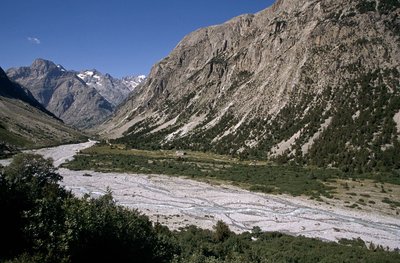
Le Plan du Carrelet - © Parc national des Ecrins - Cyril Couriser PanoramaPlan du Carrelet
At the meeting point of the Vénéon and Chardon valleys, the Plan du Carrelet is a vast plateau of glacial origin. It was originally a lake, after the glaciers withdrew, and was then gradually blocked by sediment coming down from the slopes all around, forming the vast plateau that can be seen today. Fed by the many mountain streams flowing into it, it is exceptionally rich in plant life, particularly species that are at home in wet and turbulent environments, like the banks of a mountain stream. In early summer, the plants bloom, providing an impressive sight , in the midst of the mountain pines, replanted at the beginning of the 20th century by the foresters, and which are now the prevailing species.
The Carrelet Refuge standing in the middle of the plateau was one of the oldest refuges set up by the Club Alpin Français, and dates from 1879. It is now a private residence and closed to the public.
 Know-how
Upkeep of the slopes and paths
The Restauration des Terrains en Montagne (RTM, "Restoration of Mountain Land") service, now part of the ONF, has been carrying out civil engineering work to combat erosion in the ravines near the path leading to the Temple-Ecrins refuge since 1882. Permanent monitoring and major annual maintenance work are needed to maintain thresholds, wire-mesh fencing, planting indigenous species and laying turf. Each year, the park rangers set up temporary walkways across the mountain streams.
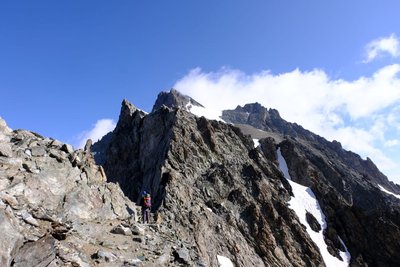
Col de la Temple - Mireille Coulon - Parc national des Ecrins  Pass
PassHigh attitude passages
The Col de la Temple (to the east of this trail), at an altitude of 3,322 m, constitutes a relatively easy passage between the Vallouise and the Vénéon. The last access slope to the pass is occupied by a small glacier that has greatly diminished in size in recent decades. The pass seems to be free of ice, but the ice is actually hidden by the stones. The story goes that once, a priest managed to go through the pass from the Vallouise to say mass at La Bérarde. Today, the pass is mainly peopled by mountain-climbers on their way to Pic Coolidge, standing at 3,774 m.
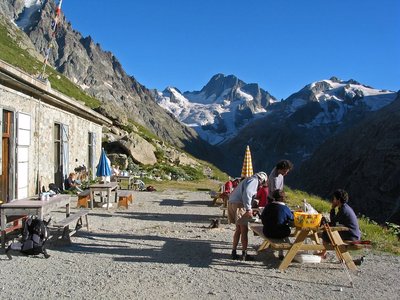
Le refuge Temple-Ecrins - © Parc national des Ecrins - Jean-Pierre Nicollet  Hut
HutTemple Ecrins Refuge
Half buried on a fine plateau facing the most beautiful peaks of the mountain range, the Temple-Ecrins Refuge takes its name from the Col de la Temple, a little higher up, and from the famous Barre des Ecrins, the highest point in the range, looking down on it. Like many other refuges in Oisans, the first was built in 1925. It was made of wood and was a little higher up than the present-day refuge. It was destroyed by an avalanche 13 years later. It was only rebuilt in 1947 by the "Jeunesse et Montagne" organisation. The refuge is easy to access and is the goal of a fine family hike rounded off by a hearty meal and the starting point of such famous Alpine races as the Col de la Temple, the Pic Coolidge or the Face Nord de la Barre.
Forecast
Altimetric profile
Sensitive areas
Golden eagle
- Impacted practices:
- Aerial, , Vertical
- Sensitivity periods:
- JanFebMarAprMayJunJulAug
- Contact:
- Parc National des Écrins
Julien Charron
julien.charron@ecrins-parcnational.fr
Golden eagle
- Impacted practices:
- Aerial, , Vertical
- Sensitivity periods:
- JanFebMarAprMayJunJulAug
- Contact:
- Parc National des Écrins
Julien Charron
julien.charron@ecrins-parcnational.fr
Recommandations
A very early start (at night) is recommended. To get the most out of this race, it is essential to be well trained and used to long walks.


Information desks
Oisans Park house
45 avenue de la République, 38520 Le Bourg d'Oisans
Video presentation of the natural resources of the Oisans mountain and its crafts. Information, documentation about the Park, projections, reading space for children. Accessible to people with reduced mobility. Free admission. All animations of the Park are free unless otherwise stated.
, 38520 Saint-Christophe-en-Oisans - La Bérarde
Transport
https://www.itinisere.fr/
https://carsisere.auvergnerhonealpes.fr/
https://zou.maregionsud.fr/
Access and parking
Parking :
More information

Source

Report a problem or an error
If you have found an error on this page or if you have noticed any problems during your hike, please report them to us here: