

Aiguilles de Chabrières
 Medium
 Trail
Important information
Dans le Parc national des Écrins, les sentiers sont généralement praticables de la mi-juin à fin septembre.
Toutefois, les périodes d'accessibilité des itinéraires et les dates de pose des passerelles varient d’une année à l’autre en fonction de l’enneigement, des dégâts survenus en hiver et des conditions météorologiques. Par ailleurs, l’état des sentiers n’est pas contrôlé quotidiennement et peut évoluer rapidement après un évènement météorologique (orage, crue...). Il est nécessaire de se renseigner auprès des maisons du parc national et des offices de tourisme du territoire avant votre sortie. Pendant la randonnée, en cas de passage dégradé ou dangereux, faites demi-tour et signalez-le.
Description
- Then take a path that veers to the right and rises quickly through the woods. Cross the Serre du mouton mountain pasture. After it levels out, the path climbs back up to an open ridge from which you can see Lake Serre-Ponçon.
- The route follows the ridge that leads to the top of the Chabrières chairlift and an orientation table. Continue along the clearly visible path, which descends slightly and continues on a balcony to reach the foot of the couloir, which you will climb up to the Brèche de Chabrières (2280 m). The path continues uphill to the ridge overlooking the village of Chorges.
- The path bypasses the Oucanes and descends across the Rougnous plateau. Continue downhill via a series of switchbacks, then keep right at the crossroads until you reach the ski slopes.
- Continue downhill to reach the resort.
- Departure : The resort of Réallon
- Arrival : The resort of Réallon
- Towns crossed : Réallon, Saint-Apollinaire, and Prunières
7 points of interest

Astragale queue de renard - Christian Couloumy - PNE  Flora
Milk Vetch
The astragalus alopercurus (from alopex: fox and oura; tail) is a spectacular plant due to its size. It has long leaves with many leaflets. It blossoms when the weather gets warmer and shows off a beautiful cluster of flowers at the top of a tall hairy stem. Several yellow corolla grow out through thick protective hair to take in the sunshine and the warm summer winds.
Chocard à bec jaune - Mireille Coulon - PNE  Fauna
Yellow-billed chough
A high flying, mountain top acrobat, the yellow-billed chough is also very talented at gathering leftovers from the walkers' picnics. It usually moves in groups and brightens up its passage with a flute-like sound that is easy to recognise. This black bird has a yellow beak and red feet, and is a much a companion to mountaineers as it is to daydreamers.
Les oucanes de Chabrières - Réallon - Mireille Coulon - PNE  Geology and geography
The Chabrières Oucanes
The Oucanes that can be seen on this walk are strange geological formations that are quite original for the Ecrins massif. The karst that they are made of is thick limestone and dolomite that is part of the Briançon fragment of Chabrières. In a limited space, the Oucanes make it possible to observe the characteristics of alpine karst: limestone pavement, meandering ribs, small rock pools, corridors with ribbed walls and Vaucluse karst springs.
Aigle royal - Pascal Saulay FaunaThe Golden eagle
The golden eagle, a large bird of prey and emblematic of mountain regions, regularly nests between Piolit and the Aiguilles de Chabrières. Boasting a wingspan of over 2 metres, it is one of the largest eagles in the world. It has an absolute command of gliding and, using updrafts, can climb to great heights to survey its territory. It is also capable of lightning-fast acceleration when swooping on prey. In the past, like all birds of prey, it was hunted down by humans, which led to its disappearance from many parts of the world. But today it is protected by law throughout Europe and its populations are doing quite well. So look up and open your eyes: you might just be lucky enough to see it gliding over the ridges in search of a marmot, its favourite prey!

Perdrix bartavelle cachée dans l'herbe - Mireille Coulon - PNE FaunaRock partridge
The rock partridge is a gallinacean, like the ptarmigan, and is easier to observe during the spring courting period. As it stands on a promontory to sing a broken song, the rock partridge is recognisable due to its grey back, white sides and throat, and its red beak. It lives in the sun on the well-exposed slopes of the mountains and likes rocks and open moors. Here its young can feed on the insects necessary for their growth.
Chamois - Robert Chevalier - PNE FaunaChamois
The creation of the National Park has enabled the chamois, emblematic animal of the Alps, to settle again in the Ecrins massif. It has short curved black horns and is a close relative of the antelope. It has a particularly well developed sense of smell and hearing. It is consequently difficult to approach. Females and kids like to group together in herds, whereas the males keep their distance until the mating season in October-November.
Pulsatille de montagne - Thierry Maillet - PNE FloraPasque flower
If all pasque flowers are identifiable by their thick but soft hairiness, unlike anemones, when they reach maturity they also have a characteristic head of scruffy hair, made up of numerous fluffy white seed heads that will get blown away by the wind. In this family, the pasque flower is the most glamorous and most beautiful. It has the advantage of flowering in spring and displays a remarkable purple-black corrola among the grass that has been faded by the winter.
Forecast
Altimetric profile
Sensitive areas
Golden eagle
- Impacted practices:
- Aerial, , Vertical
- Sensitivity periods:
- JanFebMarAprMayJunJulAug
- Contact:
- Parc National des Écrins
Julien Charron
julien.charron@ecrins-parcnational.fr
Recommandations
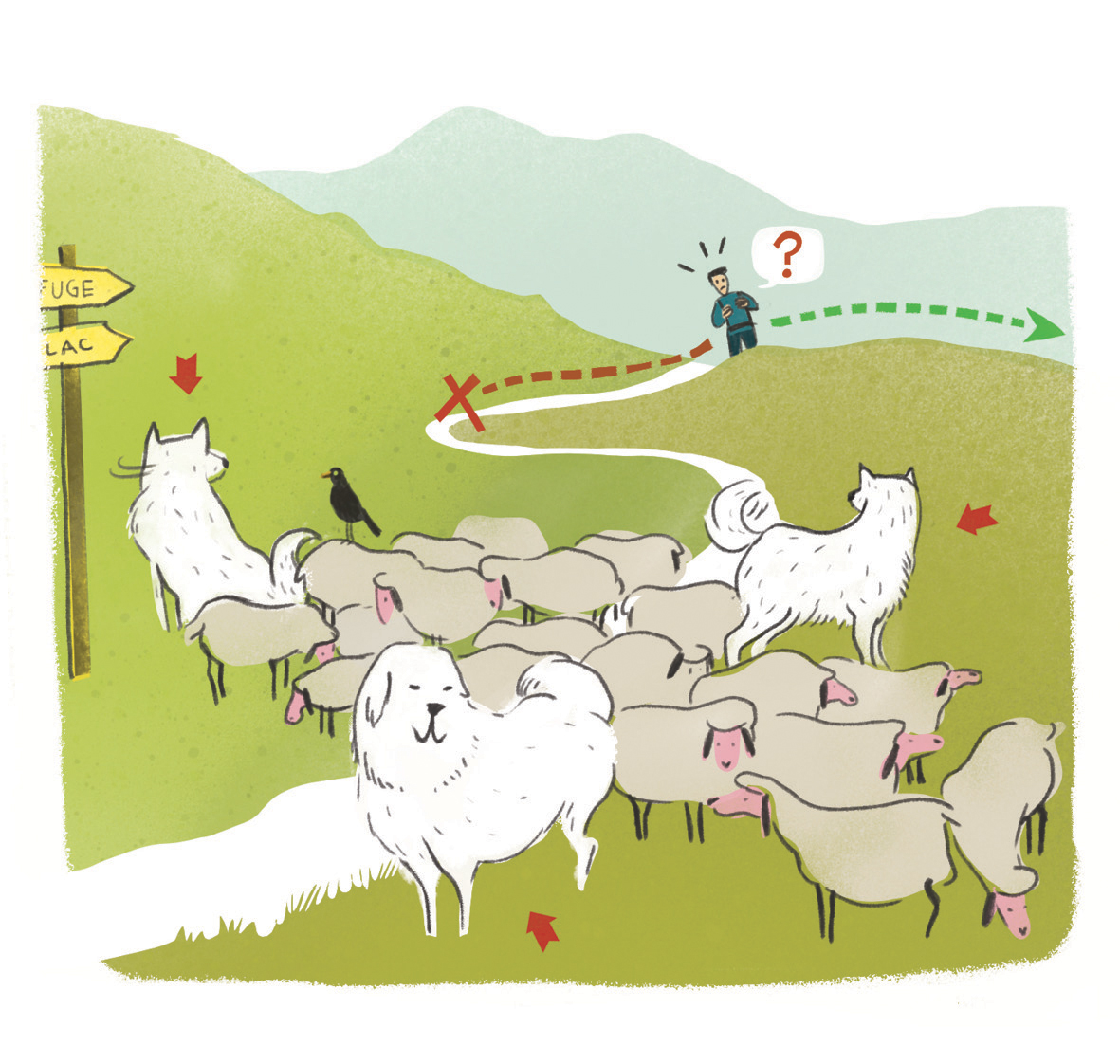 In mountain pastures, protection dogs are there to protect the herds from predators (wolves, etc.).
When I hike I adapt my behavior by going around the herd and pausing for the dog to identify me.
Find out more about the actions to adopt with the article "Protection dogs: a context and actions to adopt".
Tell us about your meeting by answering this survey.
Information desks

Tourist office Chorges
Grand rue, 05230 Chorges
October to may : Monday to Saturday, 9.00 - 12.30 & 13.30 - 17.00.
April, may, june & september : Monday to Saturday, 9.00 - 12.30 & 14.30 - 18.00
July and August : Monday to Saturday, 9:00 – 12.30 & 14.30 – 19.00 Sunday 9.30 – 12.30
Closed on Thursdays outside French holidays’ periods
Closed on French national holidays, except 14th of July and 15th of August

Tourist office Réallon Station
Pra Prunier, 05160 Réallon
July and August : Monday to Friday : 9.00 -13.00 and Saturday 13.00 - 17.00
From mid-December to March : Monday to Sunday :9.00 - 12.30 & 14.00 - 17.00
Tourist office Savines-le-Lac
9 Avenue de la Combe d'Or, 05160 Savines-le-Lac
October to march : Monday to Saturday, 9.00 - 12.30 & 13.30 - 17.00.
April, may, june & september : Monday to Saturday, 9.00 - 12.30 & 14.30 - 18.00
July and August : Monday to Saturday, 9.00 - 13.00 & 15.00 - 19.00. Sundays, 10.00 - 13.00 & 15.00 - 18.00
Closed on French national holidays, except 14th of July, and 15th of August
Closed on Thursdays outside French holidays’ periods
Tourist office Embrun
Place Général Dosse - BP 49, 05202 Embrun
October to march : Monday to Saturday, 9.00 - 12.30 & 13.30 - 17.00.
April, may, june & september : Monday to Saturday, 9.00 - 12.30 & 14.30 - 18.00
July and August : Monday to Saturday, 9.00 - 19.00. Sundays, 10.00 - 12.30 & 16.00 - 19.00
On French national holidays (except 14th of July and 15th of August) : 9am to 1pm. Closed on the 1st of January, 1st of May, 25th December and 11th November
Closed on Thursdays outside French holidays’ periods
Access and parking
Parking :
Source

Report a problem or an error
If you have found an error on this page or if you have noticed any problems during your hike, please report them to us here: