

The banks of the lake
 Medium
 Trail
Important information
Dans le Parc national des Écrins, les sentiers sont généralement praticables de la mi-juin à fin septembre.
Toutefois, les périodes d'accessibilité des itinéraires et les dates de pose des passerelles varient d’une année à l’autre en fonction de l’enneigement, des dégâts survenus en hiver et des conditions météorologiques. Par ailleurs, l’état des sentiers n’est pas contrôlé quotidiennement et peut évoluer rapidement après un évènement météorologique (orage, crue...). Il est nécessaire de se renseigner auprès des maisons du parc national et des offices de tourisme du territoire avant votre sortie. Pendant la randonnée, en cas de passage dégradé ou dangereux, faites demi-tour et signalez-le.
Description
- From the forecourt of the Tourist Office, head opposite onto Route du Fein. Pass under the bridge over the main road, then turn left until you cross the D3. Cross it and continue to the right along the pavement.
- Leave the main road and turn left onto the secondary road. Stay on this route over the railway line and pass the hamlet of Pré Long. At the intersection, take the track on the left. At the next crossroads, continue uphill to the right to reach "Champ de Gorny".
- Take a left fork onto the path, passing 2 chicanes, then take a direct right uphill to join a track. Continue left up the hill. At the crow's-foot intersection, leave the main track and continue right on the flat. Pass under the power lines twice, then leave the main path and turn left onto a downhill path.
- Continue left along the track until you reach some fields. At the signpost, continue straight ahead through marl until you reach Les Trémouilles. Bear left onto the lakeside path past Pra de l'Ase.
- At the crossroads, continue left on the flat and stay on it until you reach the "serre de l'aigle" post. From here, continue straight ahead on the path until you reach the hamlet of Chanteloube. Cross it downhill, then turn right in front of the chapel to join an uphill track. Stay on this path until you reach the hamlet of Pré Long.
- From there, the return journey takes the same route.
- Departure : Tourist Office, Chorges
- Arrival : Tourist Office, Chorges
- Towns crossed : Chorges
9 points of interest
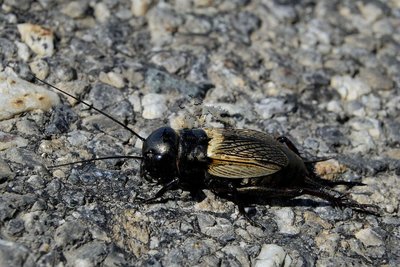
Grillon Champêtre - Mireille Coulon - PNE  Fauna
The field cricket
Just 18 to 26 mm long, this little insect has a black head which looks a little like a helmet. The female can be told apart from the male by the presence of a third long appendage at the rear of the body. The cricket’s song is heard from April onwards. The male sings his chirping song from the entrance to his burrow. The fertile females lay their eggs in the ground, which remain there for two weeks before the larvae emerge.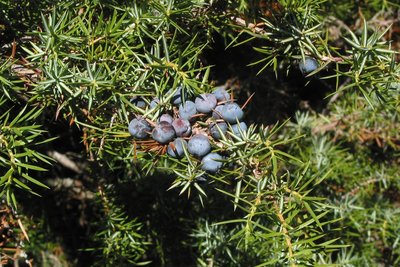
Genévrier commun - Jean-Pierre Nicollet - PNE  Flora
Common juniper
This bush is a resinous evergreen conifer. It is characterised by its greenish to blue (glaucous) needles with a white line on their upper side, and fruits resembling blue-black berries. It usually tends to grow in warm environments receiving plenty of sunlight. It grows in grassy or scrub covered areas up to 2,000 metres above sea level.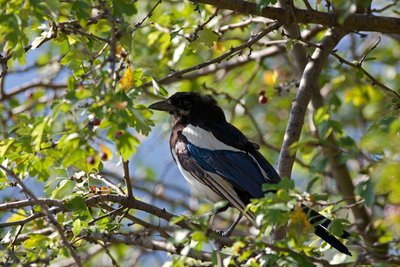
Pie bavarde - Pascal Saulay - PNE FaunaCommon magpie
This bird can be identified by its black and white plumage with blue-green tints on the wings and tail. Its tail is remarkably long. It can be found all year round in varied open environments. Its omnivorous diet consists of invertebrates, seeds and berries, small rodents, eggs and nestlings and even human rubbish. Except during the nesting period when it is solitary, the magpie is gregarious species which gathers into rather raucous groups in the winter.
Héron cendré - Pascal Saulay - PNE FaunaGrey heron
This is a tall bird (85 to 102 cm). Its white head is adorned with two large black eyebrows. Its back and wings are ash grey, hence its name. Its legs and beak are yellowish in colour. It uses its long, powerful beak to catch large prey (fish, amphibians etc.). In flight, its neck is folded back forming an «S». This species is wholly protected by regulations.
Lézard vert - Mireille Coulon - PNE FaunaWestern green lizard
This lizard can be spotted from April through to late September. The species is in hibernation for the rest of the year. It hunts in areas with dense vegetation and feeds primarily on insects and invertebrates. It exhibits sexual dimorphism, that is to say, during the breeding season only, the males have bright blue colouring on the throat and sides of the head. Mating takes place around May. The males engage in fights, in which they occasionally lose their tails.

Chêne Pubescent - Christian Baïsset - PNE FloraDowny oak
The oak has a dark grey bark which is deeply fissured. Its lobed leaves, downy on their undersides, remain dried out on the tree until the spring. The fruits, called acorns, ripen in the autumn. The oak can grow at up to 1,500 metres above sea level, on well exposed slopes. Also called the white oak, the downy oak is well known for hosting truffles among its roots. This fungus develops 30 to 40 cm underground, and the difficulty in finding it makes it a culinary delicacy.
Zygène de la bugrane - Pascal Saulay - PNE FaunaBurnet moth
This is a medium-sized moth (25 - 35 mm wingspan), often brightly coloured: the inner wing has a maximum of six spots. This burnet moth is found on the edges of calcareous meadows, steppe-like slopes, dry bushes and clearings in dry forests. This remarkable species is a sign of the quality of the habitats but it is not at risk so does not appear on the list of threatened species.
Papillion azuré - Jean-Marie Gourreau - PNE FaunaThe Common Blue
In this small butterfly, the male's upper wings are dark grey, somewhat bluer at the base of the wings, while the female is brown. It is most common at higher altitudes, in July and August, in grasslands and meadows. The Arctic Blue is a species of northern regions (Scandinavia, Greenland, Siberia, North America) which, in more temperate parts, lives only in the mountains.
.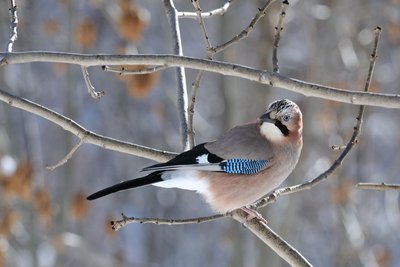
Geai des chênes - Mireille Coulon - PNE FaunaEurasian jay
The Eurasian jay has a colourful plumage. Its black tail and blue wing streak helps to identify this relatively shy bird. It regularly utters raucous caws, but also frequently imitates the calls of several other species. In late winter, jays assemble in groups and sing as a choir, uttering whistles and chirps in a cheerful chatter. They all display their finest feathers and adopt comical attitudes, in preparation for forming into pairs.
Forecast
Altimetric profile
Information desks

Tourist office Chorges
Grand rue, 05230 Chorges
October to may : Monday to Saturday, 9.00 - 12.30 & 13.30 - 17.00.
April, may, june & september : Monday to Saturday, 9.00 - 12.30 & 14.30 - 18.00
July and August : Monday to Saturday, 9:00 – 12.30 & 14.30 – 19.00 Sunday 9.30 – 12.30
Closed on Thursdays outside French holidays’ periods
Closed on French national holidays, except 14th of July and 15th of August
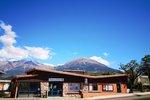
Tourist office Savines-le-Lac
9 Avenue de la Combe d'Or, 05160 Savines-le-Lac
October to march : Monday to Saturday, 9.00 - 12.30 & 13.30 - 17.00.
April, may, june & september : Monday to Saturday, 9.00 - 12.30 & 14.30 - 18.00
July and August : Monday to Saturday, 9.00 - 13.00 & 15.00 - 19.00. Sundays, 10.00 - 13.00 & 15.00 - 18.00
Closed on French national holidays, except 14th of July, and 15th of August
Closed on Thursdays outside French holidays’ periods
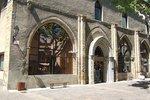
Tourist office Embrun
Place Général Dosse - BP 49, 05202 Embrun
October to march : Monday to Saturday, 9.00 - 12.30 & 13.30 - 17.00.
April, may, june & september : Monday to Saturday, 9.00 - 12.30 & 14.30 - 18.00
July and August : Monday to Saturday, 9.00 - 19.00. Sundays, 10.00 - 12.30 & 16.00 - 19.00
On French national holidays (except 14th of July and 15th of August) : 9am to 1pm. Closed on the 1st of January, 1st of May, 25th December and 11th November
Closed on Thursdays outside French holidays’ periods
Transport
Access and parking
Parking :
More information

Source

Report a problem or an error
If you have found an error on this page or if you have noticed any problems during your hike, please report them to us here: